Designing the logistics network is no longer a discussion restricted to the logistics team. In more volatile markets, with the growth of e-commerce, multiple channels, cost pressures and demands for faster service, the study of the logistics network (Network Design) has become a topic discussed by various sectors of companies.
In Brazil, the complexity increases: in addition to volume, distance and infrastructure, taxation, tax incentives, regional differences and regulatory risk come into play, which makes the use of quantitative models and scenario simulation even more relevant.
What Network Design is in practice
In general terms, we are talking about deciding how many distribution centers and factories the company should have, where to locate them, how to connect them and which modes to use, balancing cost, service level and risks.
In practice, Network Design is the process of answering questions such as:
- How many DCs, factories and hubs does the company need?
- Where does it make the most sense to locate them, considering demand, suppliers, infrastructure and taxes?
- Which flow design (who supplies whom) is most efficient?
- Which modes of transport should I use in each corridor?
- How much does this configuration cost - today and in the future - to maintain the desired level of service?
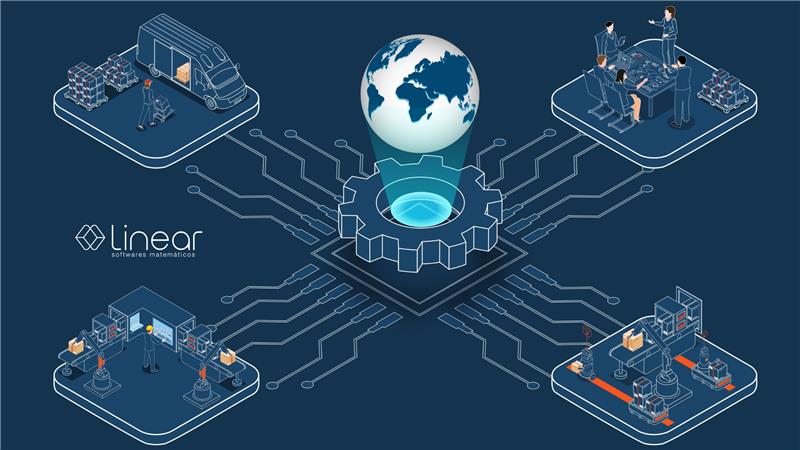
In other words, it is the design of the physical network of the supply chain, connecting suppliers, plants, DCs and end customers. The classic objective is to minimize the total cost while maintaining (or improving) the level of service.
Location, modes and cost-to-serve
Deciding where to locate factories, DCs and hubs is one of the most sensitive decisions in network design. Factors such as proximity to demand and suppliers, infrastructure, local costs, tax incentives and regional risks directly influence the cost and level of service. While a poorly located network erodes margin, a well-designed network sustains competitiveness for years.
The choice of modes in each section of the network completes this design. Combining road, rail, cabotage and, when it makes sense, air transport changes the cost per order, lead time, reliability and even the ESG agenda. Network Design models allow you to compare these combinations with numbers, rather than just intuition.
From a cost point of view, the focus is no longer just on "freight per bill", but on cost-to-serve: primary and secondary transportation, warehousing, handling, inventories, taxes and investments in assets. Well-structured network studies show how much it costs to serve each region or channel today and how much it could cost in an alternative configuration, supporting more conscious decisions about prices, SLAs and expansion.
5-step Network Design Guide
1. Start with the business questions, not the map
A good Network Design project starts by defining questions such as:
- Do we want to reduce total logistics costs by X%?
- Do we need to shorten deadlines in certain regions?
- Are we going to open new channels (D2C, e-commerce, marketplace, B2B)?
- Are there emissions targets, risk or fiscal exposure that need to be considered?
This guides the model: what will be optimized, which restrictions cannot be violated and which trade-offs make sense to consider.
2. Map the current network (baseline) with real data
Before proposing any changes, it is essential to build a robust baseline of the current network:
- Where are the factories, DCs, hubs, stores, cross-docking points?
- Where everyone sends and receives;
- Volumes handled, lead times, service levels;
- Transportation costs (by route and modal), storage, handling, taxes, additional freight, etc.
This quantitative map is the starting point for any comparison. Without it, it's impossible to say whether a new scenario is better or worse, or how much "money is on the table".
3. Build the database for location, modes and costs
Then comes the work of consolidating the data that feeds the mathematical model:
- Geographical demand: by region, channel, customer or delivery point.
- Logistics costs by modal and route: road, rail, cabotage, air, multimodal.
- Capacities: production limits, storage, docks, receiving windows.
- Fiscal and financial aspects: taxes, incentives, foreign exchange (where applicable).
Solutions such as Linear's Otimix have already been designed to incorporate financial aspects, taxes, resource availability and suppliers into the network modeling itself, integrating logistical and economic vision into a single decision-making model.
4. Run location, modal and cost scenarios
With the model calibrated, the most strategic part begins: testing scenarios. Some typical examples:
- Centralizing the operation in fewer DCs or spreading it across more regional units;
- Open a new center in the Northeast or Midwest to reduce lead time;
- Replacing part of the road with rail or cabotage in certain corridors;
- Selective use of air travel for certain premium services;
- Scenarios of "minimum possible cost" versus "best possible service level";
- Trade-offs between cost, service, risk and, where applicable, CO₂ emissions.
The model helps to quantify each alternative: how much it costs, what level of service it delivers, which capacities are bottlenecked and where there is slack.
5. Transform the result into a roadmap and governance
Network Design doesn't end with an "optimal map" on a slide. The result needs to become an implementable roadmap, with:
- Short-, medium- and long-term actions (e.g. change flows first, open CD later).
- Connection with capex, logistics contracts and commercial strategy.
- Monitoring indicators (baseline versus implemented scenario).
And, above all, governance to review the network whenever the context changes - accelerated growth, change in consumer profile, M&A, new tax or regulatory requirements.
Network Design as a lever for competitiveness
Network Design is not an academic exercise in pretty maps: it is one of the main strategic levers for reducing structural costs, improving service levels and increasing resilience in complex supply chains.
If your company is considering opening or closing units, reviewing modes, shortening deadlines or reducing structural logistics costs, this is the ideal time to put Network Design at the center of the discussion.
Linear Softwares Matemáticos specializes in bringing mathematical intelligence to supply chain decision-making, with solutions that combine optimization, AI and scenario simulation.
With Otimix Network Design, Linear's software for studying logistics networks, developed over more than 20 years, it's possible:
- Build a faithful model of the current network (baseline);
- Test different numbers and locations of factories, DCs and hubs;
- Compare modal combinations and service strategies;
- Quantify the impact on total cost, service level and risk for each scenario;
- Support the continuous evolution of the network, not just a "one-off project".
Want to decide which network design makes the most sense for your business?
Contact Linear and find out how a well-executed Network Design project can turn into a sustainable competitive advantage for your supply chain.